> For the complete documentation index, see [llms.txt](https://docs-v3.toucantoco.com/llms.txt). Markdown versions of documentation pages are available by appending `.md` to page URLs; this page is available as [Markdown](https://docs-v3.toucantoco.com/visualizations-and-layouts/self-service/self-service-dashboard/the-in-platform-self-service-dashboard.md).
# The in-platform Self-Service Dashboard
### Key Features
#### Dashboard Creation
* The dashboard is accessible to all users, including both App Builders and Viewers.
* Viewers have the ability to create, edit, and delete dashboards in production mode. App Builders can perform the same actions in staging mode.
* Viewers can create and edit a dashboard:
* Add charts: Select from a library of available charts to enhance a dashboard.
* Remove charts: Remove any charts that aren't relevant.
* Rearrange the layout: Move and resize charts to better organize the dashboard.
#### Platform Access Management
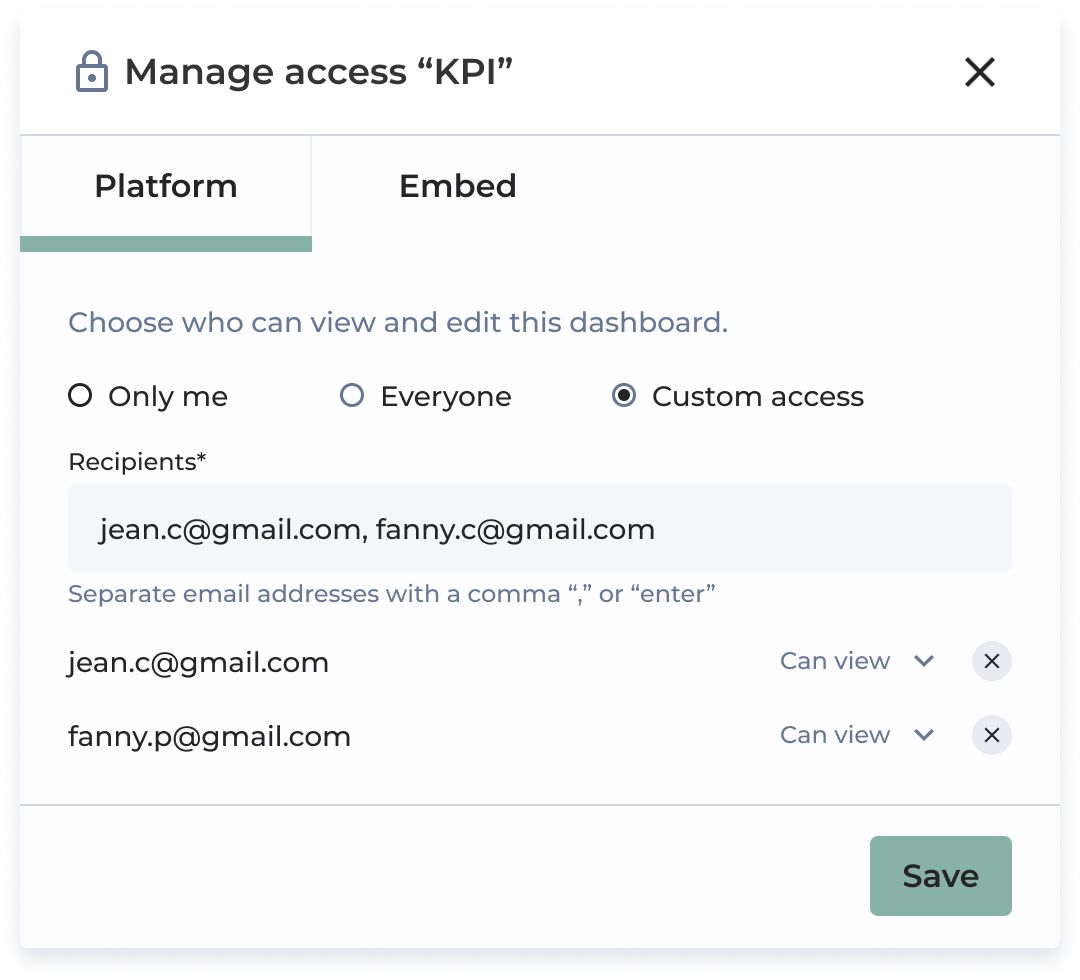
* Dashboard access rights can be finely configured:
* **Only me**: only the dashboard creator can view it.\
(*This is the default option when creating a new dashboard.*)
* **Everyone**: all users of the Toucan application where the dashboard is located can access it.
* **Custom**: this option allows you to share the dashboard with one or more specific people, based on their email address. *(The email must correspond to an existing Toucan user.)*
* When a dashboard is shared with everyone or via custom access, the user can choose to grant either of the following permission levels:
* **View-only access:** the **"can view"** option allows a user to view, download, and duplicate the dashboard.
* **Edit access**: the **"can edit"** option allows a user not only to view, download, and duplicate the dashboard, but also to edit, delete, and manage its access settings.
Access Modal
#### Embed Configuration: Restricted to App Builders
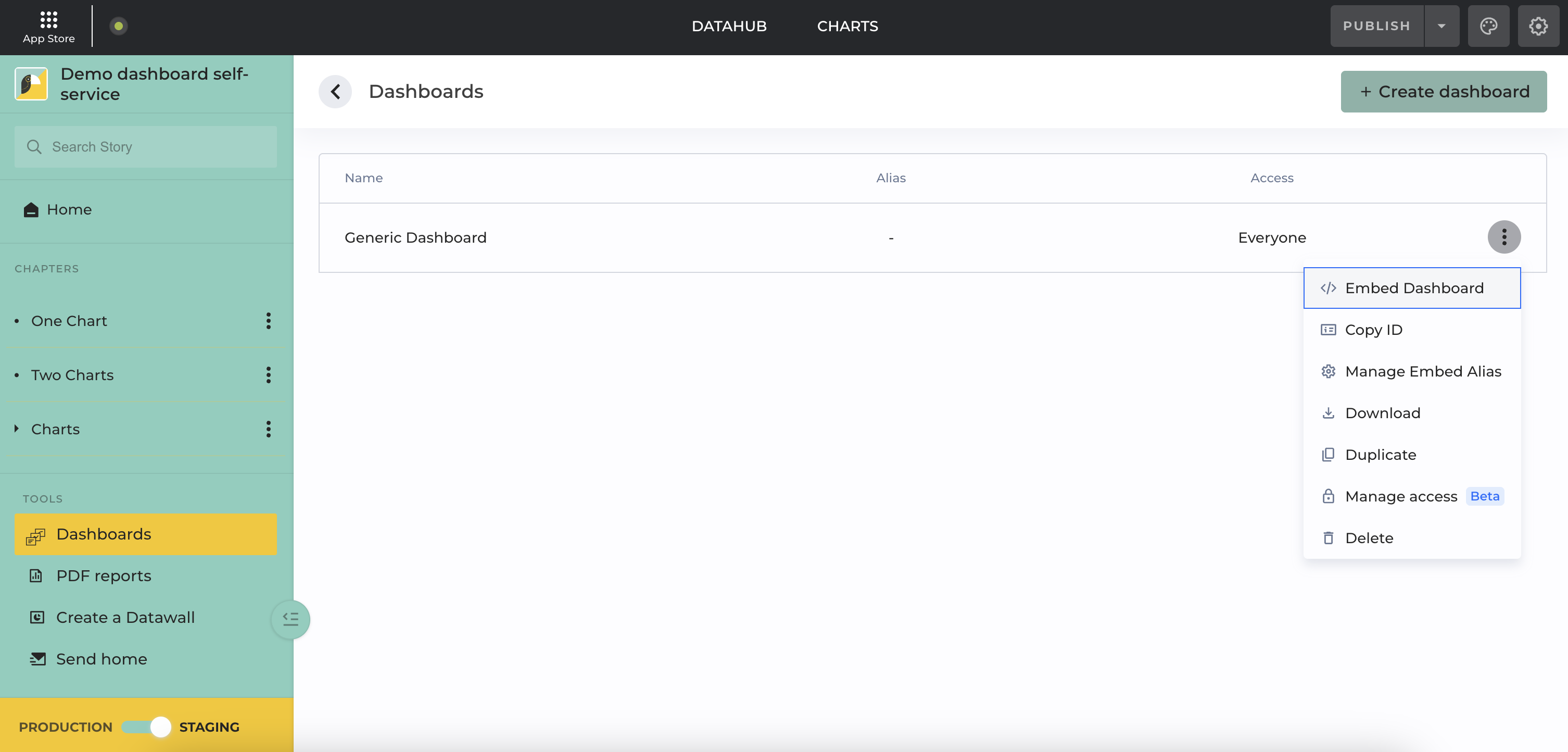
Some dashboard options are strictly reserved for App Builders.\
\&#xNAN;*(These options are therefore not visible to Viewers on the platform.)*
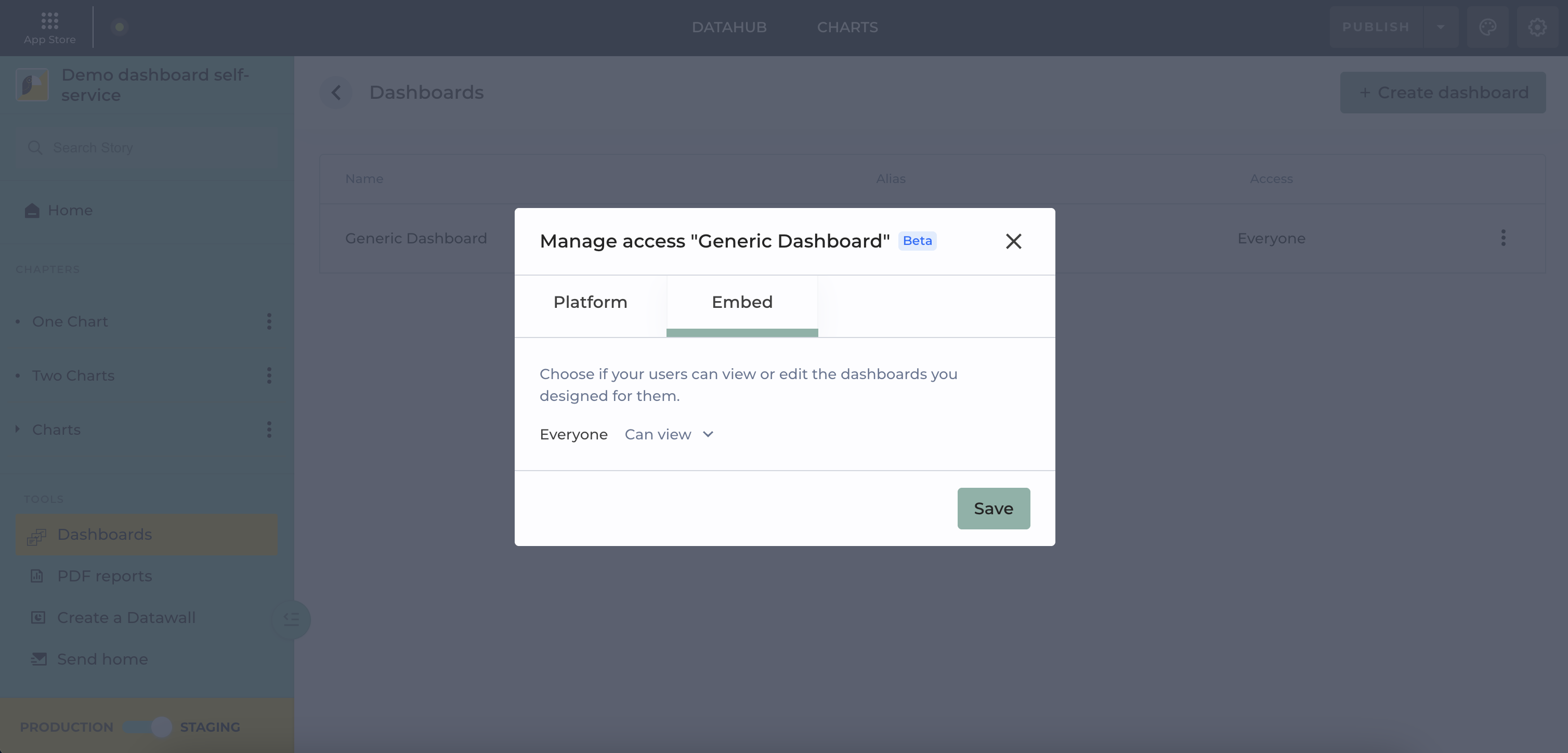
Options reserved for App Builders
Screenshot
Embed Dashboard
Copy ID
Manage Embed Alias
Manage Embed Access
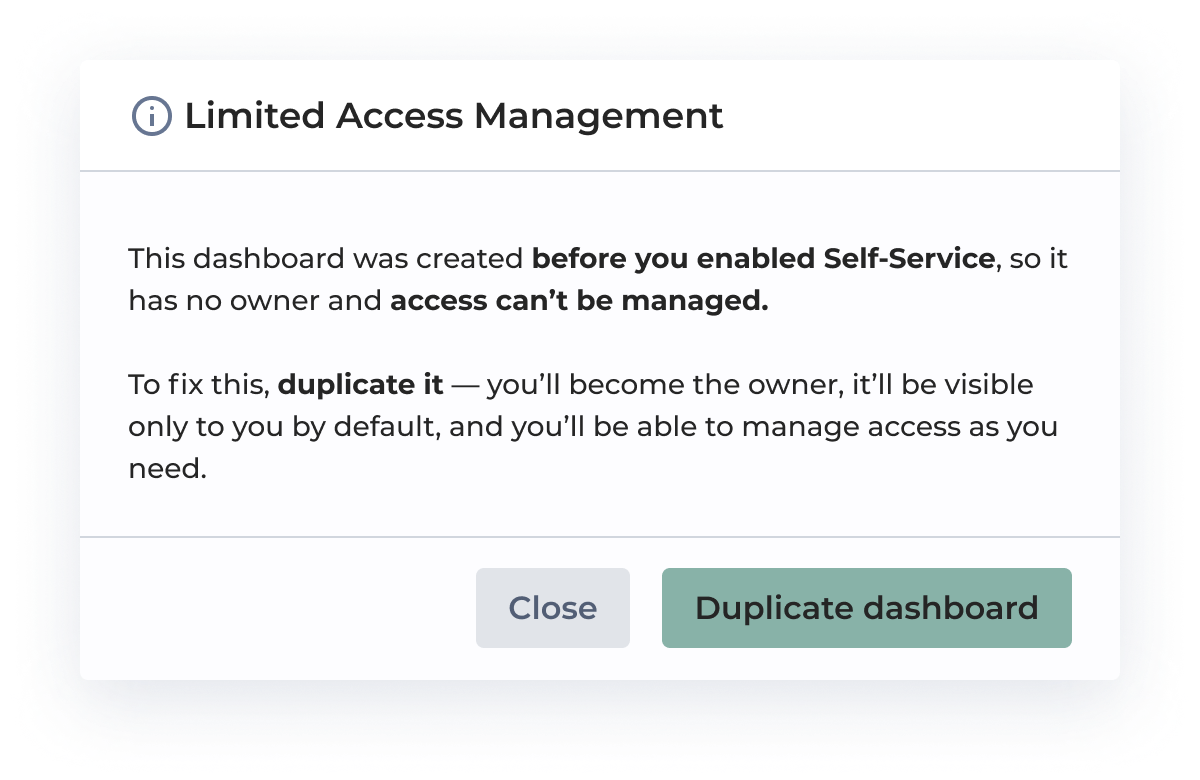
**Limited Access for Legacy Dashboards**
When the 'Self-service' option is enabled, users will still see the Dashboards that were already present in the Toucan application. Here are a few default rules to know about these migrated Dashboards:
* All App Builders will still be able to edit them.
* All Viewers will still be able to view them.
* Access management is limited. To benefit from full access control, you can duplicate the dashboard. The user who performs the duplication automatically becomes the owner of the copy. By default, the duplicated dashboard is only visible to them. The user can then manage access rights using the platform’s sharing options: 'only me', 'everyone', or 'custom'.\\
Limited Access Modal
### Frequently Asked Questions
| Question | Answer |
| --------------------------------------------------------------------------- | ---------------------------------------------------------------------------------------------------------------------------------------------------------- |
| What occurs when a dashboard is edited by both a Viewer and an App Builder? | When a dashboard is shared between Viewers and App Builders, the staging and production versions are automatically synced when the dashboard is published. |
{% hint style="info" %}
This feature is in Beta. Please contact your Customer Success Manager (CSM) to activate it in your workspace.
Also please note this is a paid feature.
{% endhint %}
---
# Agent Instructions
This documentation is published with GitBook. GitBook is the documentation platform designed so that both humans and AI agents can read, navigate, and reason over technical content effectively. Learn more at gitbook.com.
## Querying This Documentation
If you need additional information that is not directly available in this page, you can query the documentation by asking a question.
Perform an HTTP GET request on the following URL with the `ask` and `goal` query parameters:
```
GET https://docs-v3.toucantoco.com/visualizations-and-layouts/self-service/self-service-dashboard/the-in-platform-self-service-dashboard.md?ask=&goal=
```
`ask` is the immediate question: it should be specific, self-contained, and written in natural language.
`goal` is what the user is ultimately trying to achieve, the reason they need the answer. Sharing it helps GitBook give you a better, more relevant answer. A goal is most helpful when it describes the outcome the user wants rather than restating the question. For example, with `ask=how do I create an API token`, a goal like `automate deployments from our CI pipeline` lets GitBook tailor the answer to that use case.
The response will contain a direct answer to the question and relevant excerpts and sources from the documentation.
Use this mechanism when the answer is not explicitly present in the current page, you need clarification or additional context, or you want to retrieve related documentation sections.