> For the complete documentation index, see [llms.txt](https://docs-v3.toucantoco.com/llms.txt). Markdown versions of documentation pages are available by appending `.md` to page URLs; this page is available as [Markdown](https://docs-v3.toucantoco.com/additional-ressources/troubleshooting/cross-site-cookies.md).
# Cross-Site Cookies
Cookies are saved in your browser by Toucan to store securely your authentication state.
For some instances that have specific configuration, Cross-Site Cookies (or third-party cookies) are required for Toucan to work properly, thus they have to be enabled for you to connect.
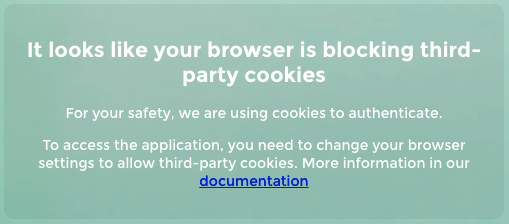
Some browser do not allow Cross-Site Cookies by default and you might encounter an error message asking you to enable them.
Toucan - blocking third party cookies
### How to allow Cross-Site Cookies
These will help you enable them for every website, you can also enable them only for Toucan, to do so look at your browser’s help page.
You may need to restart your browser after the changes.
If your browser is not listed below, please refer to your browser’s help pages
### Google Chrome
#### PC and Mac
* Select the Chrome menu icon
* Select Settings.
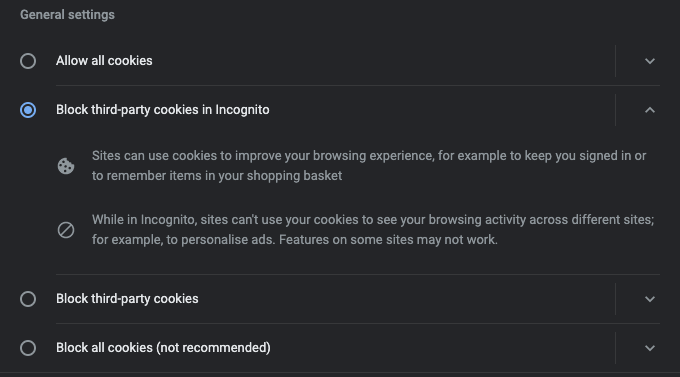
* In the “Privacy and security” section, select “Cookies and other site data”.
* Allow cookies
General settings - chrome
#### Android
* Open the Chrome app.
* At the top right, tap More More and then Settings.
* Tap Site settings and then Cookies.
* Next to “Cookies,” switch the setting on.
* Check the box next to “Allow third-party cookies.”
### Safari
#### Mac
* Go to the Safari drop-down menu.
* Select Preferences.
* Click Privacy in the top panel.
* Under ‘Block cookies’ select the option ‘Never.’
#### iPhone/iPad
* Open your Settings.
* Scroll down and select Safari.
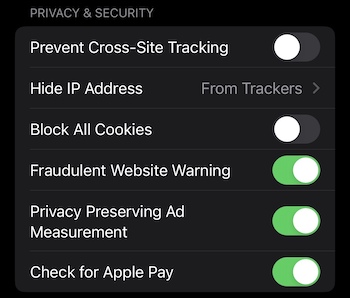
* Under Privacy & Security, turn off “Prevent Cross-Site Tracking” and “Block All Cookies”.
Privacy & security Safari
### Mozilla Firefox
#### PC and Mac
* Go to the Firefox drop-down menu.
* Select Settings.
* Click Privacy & Security
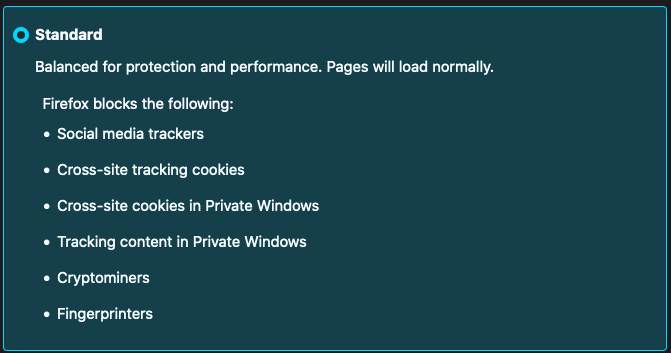
* Select `Standard`
standard - firefox
---
# Agent Instructions
This documentation is published with GitBook. GitBook is the documentation platform designed so that both humans and AI agents can read, navigate, and reason over technical content effectively. Learn more at gitbook.com.
## Querying This Documentation
If you need additional information that is not directly available in this page, you can query the documentation dynamically by asking a question.
Perform an HTTP GET request on the current page URL with the `ask` query parameter, and the optional `goal` query parameter:
```
GET https://docs-v3.toucantoco.com/additional-ressources/troubleshooting/cross-site-cookies.md?ask=&goal=
```
`ask` is the immediate question: it should be specific, self-contained, and written in natural language.
`goal` is optional and describes the broader end goal you are ultimately trying to accomplish on behalf of the user. GitBook uses it to tailor the answer towards what is most useful for that goal.
The response will contain a direct answer to the question and relevant excerpts and sources from the documentation.
Use this mechanism when the answer is not explicitly present in the current page, you need clarification or additional context, or you want to retrieve related documentation sections.