> For the complete documentation index, see [llms.txt](https://docs-v3.toucantoco.com/llms.txt). Markdown versions of documentation pages are available by appending `.md` to page URLs; this page is available as [Markdown](https://docs-v3.toucantoco.com/collaboration/sharing-content.md).
# Sharing content
Accessible by any user
On Toucan, you can share different content with anyone:
* Home page
* Stories
* PDF reports
#### Sharing
You can share with existing users or people not listed in the instance. They will receive the email based on the **"Export template"** you defined in the "[Notifications](/collaboration/managing-notifications.md)" of the instance or the ones on the application itself.
* Home & PDF reports: Click "Send home" in the left-hand navigation accessible from the Home. From the Home preview, click on the "Mail" icon.
* Stories: from the left-hand nav, click on the story name you want to share, click on the "share" icon at the right of the story name, and select "Send by email." It will correspond to the current state of the story, with current filters' selections.
* In the dialog, add the emails of the recipients. Tap the "Tab" or "Enter" keys between each email to separate the addresses.
### **Annotate and share**
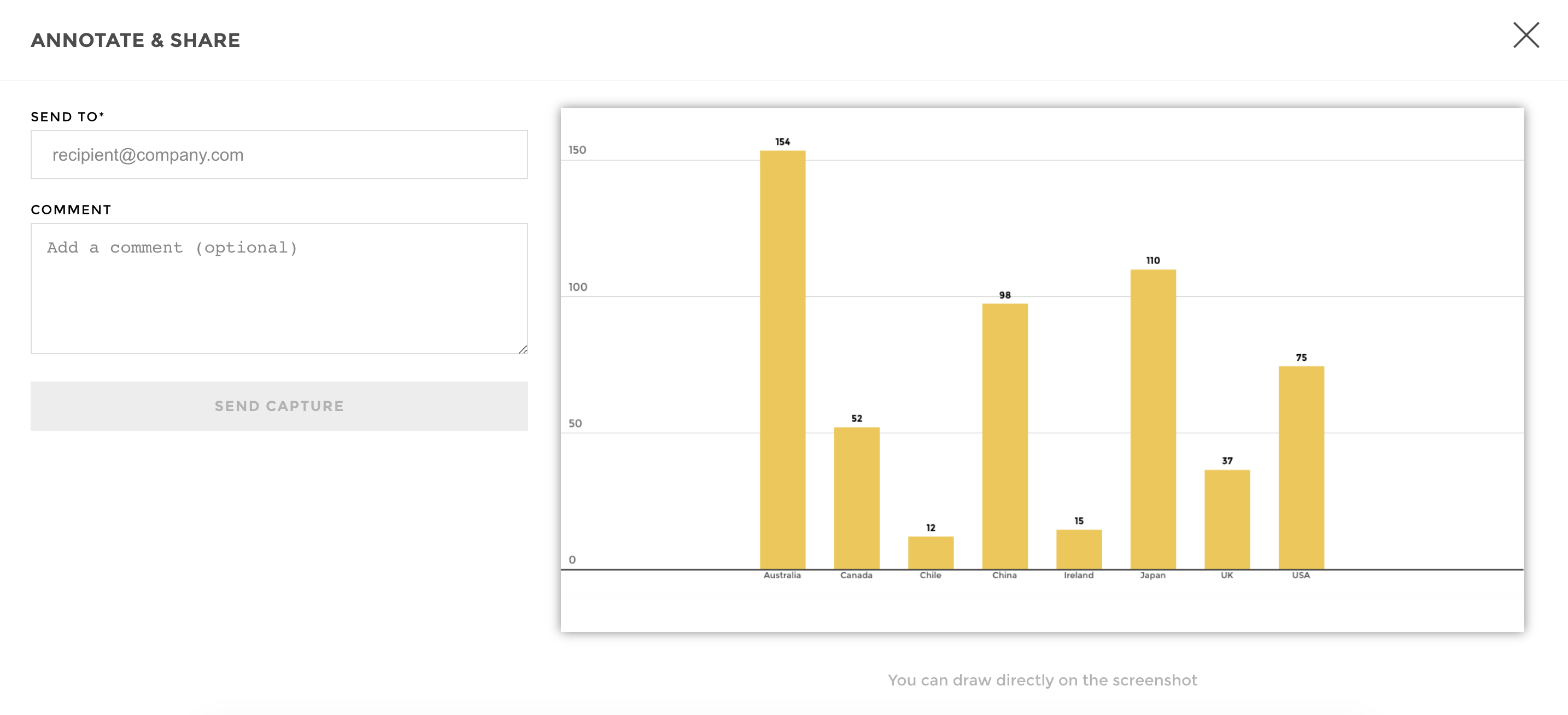
This option allows your user to **annotate a screenshot of a chart** (without the header giving some context about the current report/date) ✍️ and share it to any email address with a **custom message** ✉️.
annotate-share
### Export data
This will allow your user to **download the data** from your viz, either to CSV or XSLX.
It will match the result of your current filters.
### **Share Link**
Users can get **a link to a story** that keeps filter selections intact. Recipients need to be connected to access it.
{% hint style="info" %}
**Hint**\
In the Share menu from a Story when user has "contribute" privileges, you can generate an HTML code to embed the story into another web app.[ Learn more.](/visualizations-and-layouts/embedding/integration/generate-and-manage-embeds.md)
{% endhint %}
---
# Agent Instructions
This documentation is published with GitBook. GitBook is the documentation platform designed so that both humans and AI agents can read, navigate, and reason over technical content effectively. Learn more at gitbook.com.
## Querying This Documentation
If you need additional information that is not directly available in this page, you can query the documentation by asking a question.
Perform an HTTP GET request on the following URL with the `ask` and `goal` query parameters:
```
GET https://docs-v3.toucantoco.com/collaboration/sharing-content.md?ask=&goal=
```
`ask` is the immediate question: it should be specific, self-contained, and written in natural language.
`goal` is what the user is ultimately trying to achieve, the reason they need the answer. Sharing it helps GitBook give you a better, more relevant answer. A goal is most helpful when it describes the outcome the user wants rather than restating the question. For example, with `ask=how do I create an API token`, a goal like `automate deployments from our CI pipeline` lets GitBook tailor the answer to that use case.
The response will contain a direct answer to the question and relevant excerpts and sources from the documentation.
Use this mechanism when the answer is not explicitly present in the current page, you need clarification or additional context, or you want to retrieve related documentation sections.