> For the complete documentation index, see [llms.txt](https://docs-v3.toucantoco.com/llms.txt). Markdown versions of documentation pages are available by appending `.md` to page URLs; this page is available as [Markdown](https://docs-v3.toucantoco.com/administration/managing-users/managing-user-groups.md).
# Managing user groups
As an app administrator at both the app store and application levels, you can learn how to add and modify user groups.
### Choose who sees what
A user group is a group of users who share the same permissions and/or app access privileges.\
Think of it as a filter on data 🔐 that can also simplify the governance process by providing the same app access to all users in a group.
📝 “My users from the group France can only see France’s data and reports”\
📝 “I want all users from the group France to have a view access to the Finance application”
The process consists of two steps:
* Assign users and privileges to groups
* Assign permissions to groups
### User groups
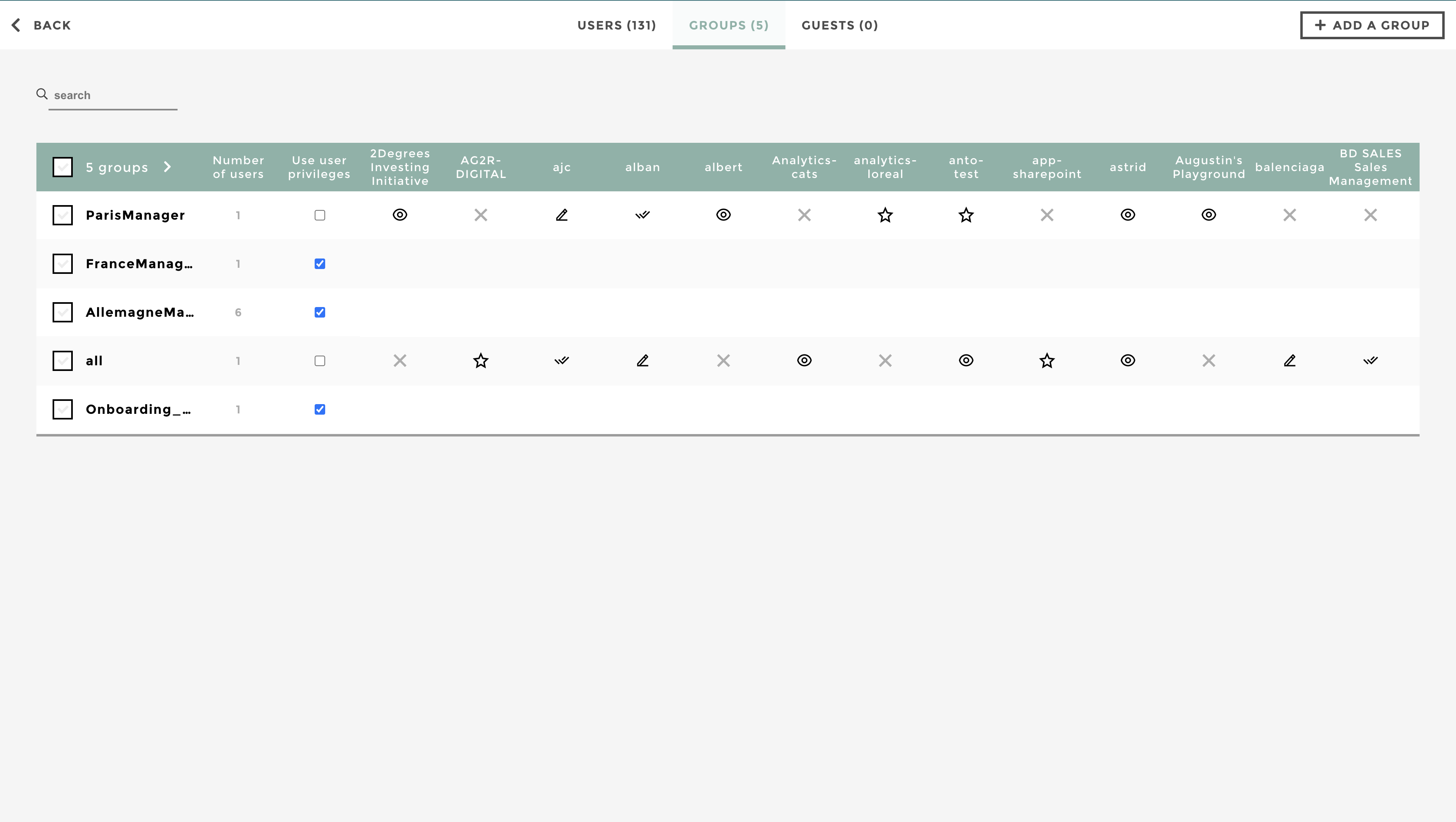
As an admin, you can manage user groups from the **Groups** menu in the user interface at the platform level.
#### Create groups
You can create users from the **Create groups** at the top right side of your screen.
{% hint style="info" %}
**Hint**
Groups can also be assigned during user creation or through bulk editing
{% endhint %}
Creating groups involves three steps :
* General infos
* Edit privileges
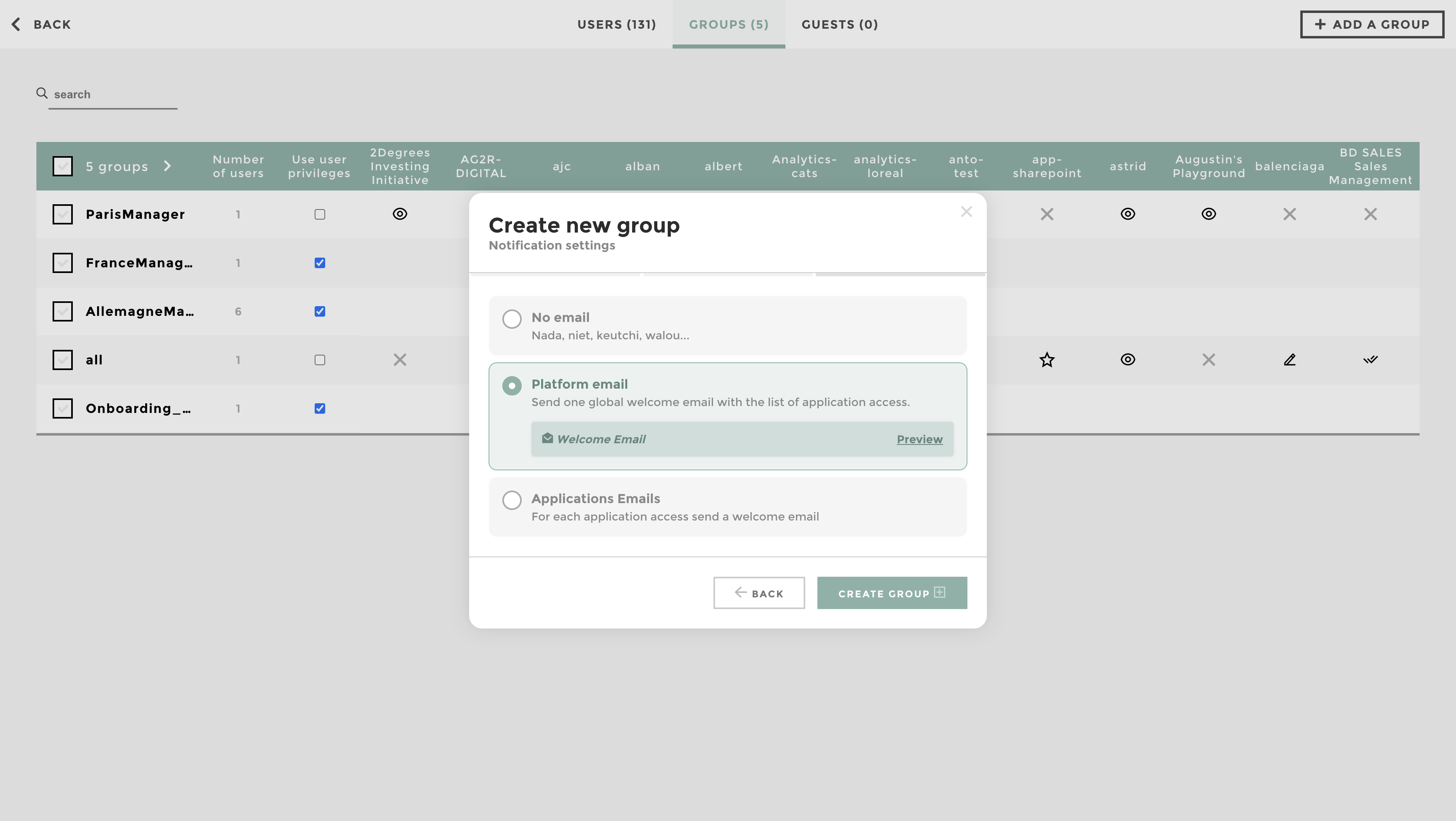
* Notification settings
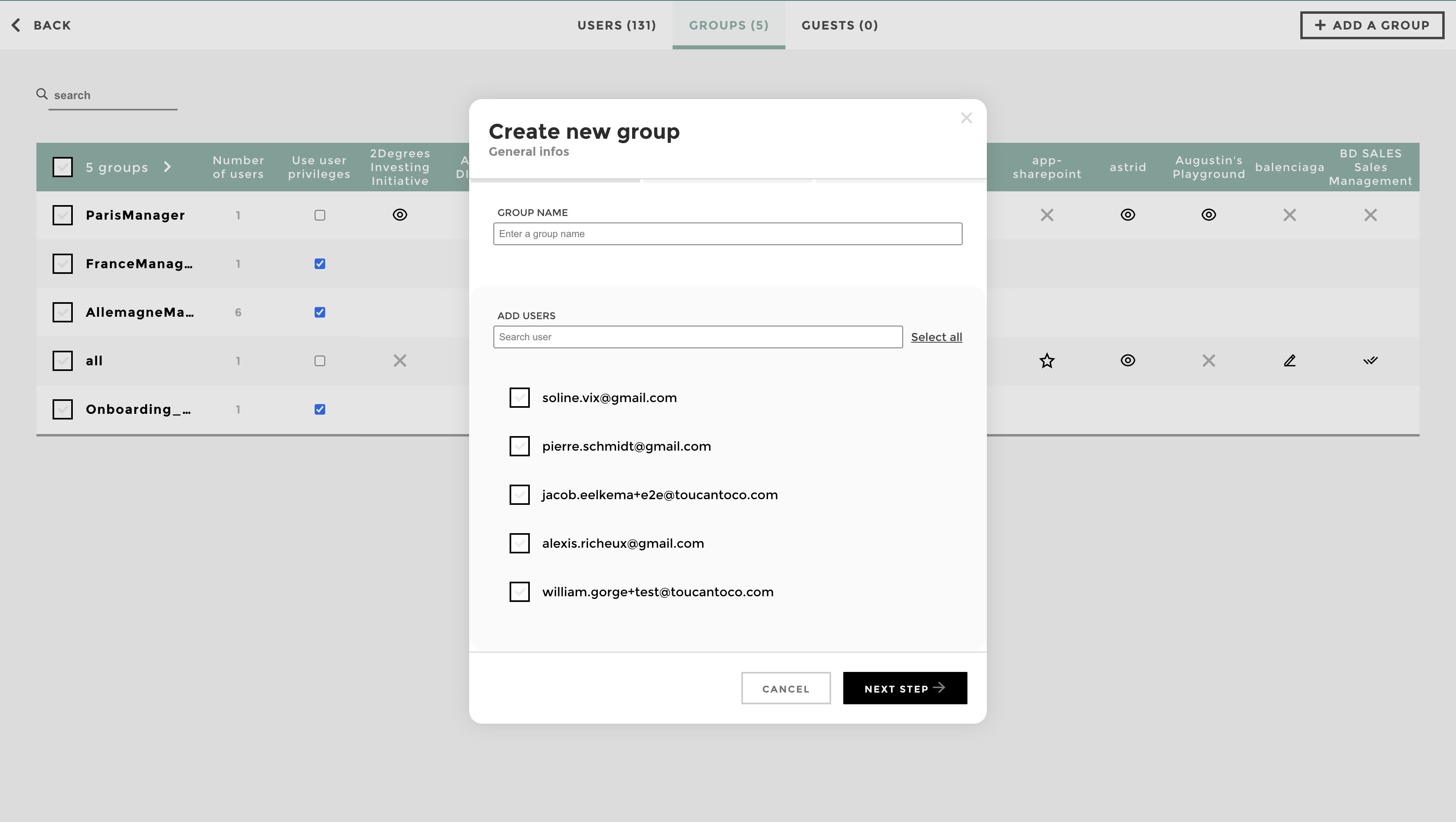
**General infos**
In this step, you need to :
* Give your group a name
* Select user(s) for your group
{% hint style="info" %}
**Hint**
if users belong to multiple groups with different app access, the most permissive access for each app will be applied.
Admins will always keep their admin privilege if belonging to a group.
{% endhint %}
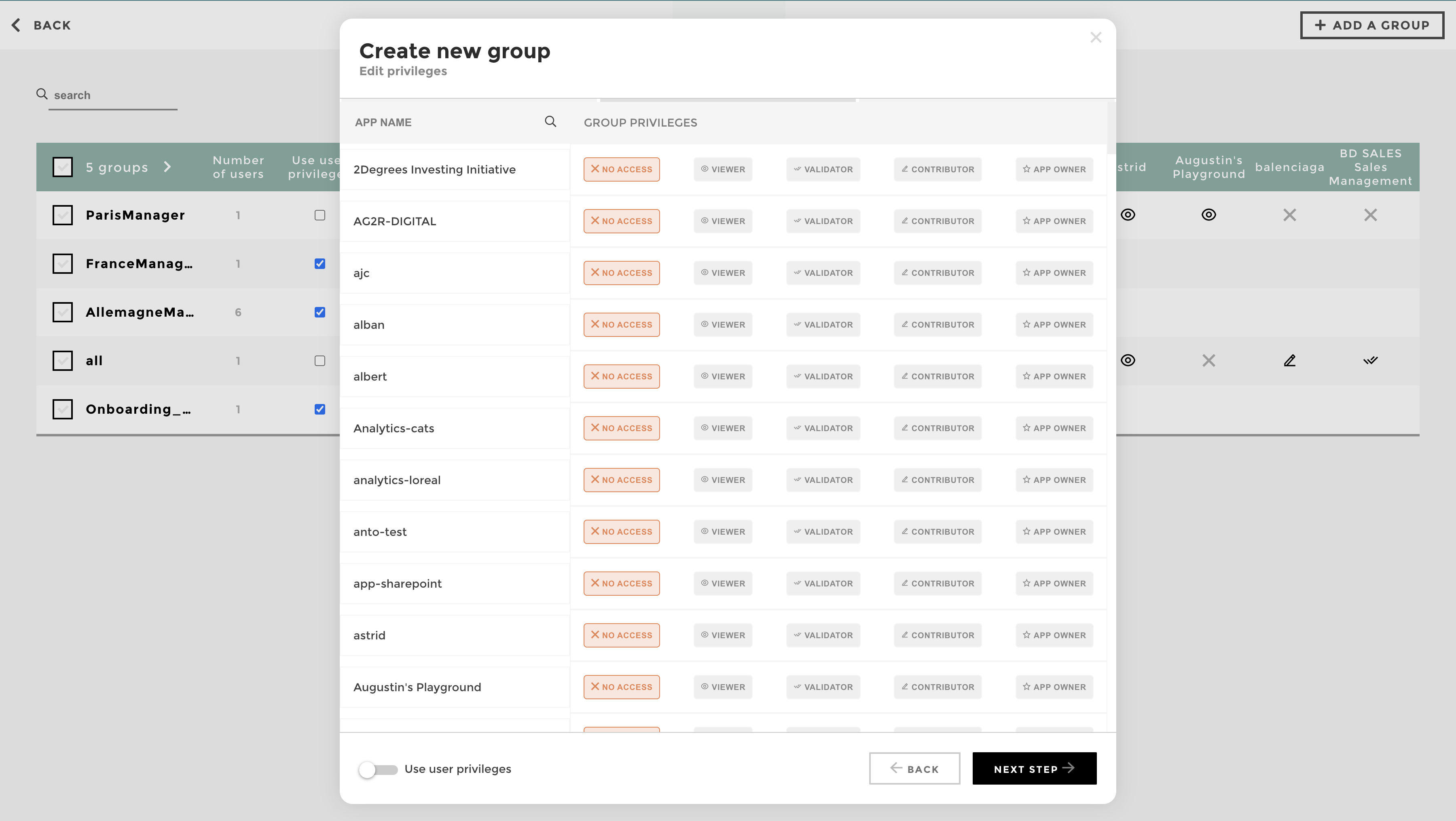
**Edit privileges**
In this step, you need to define, application by application, which access to give to users belonging to the group.
{% hint style="info" %}
**Hint**
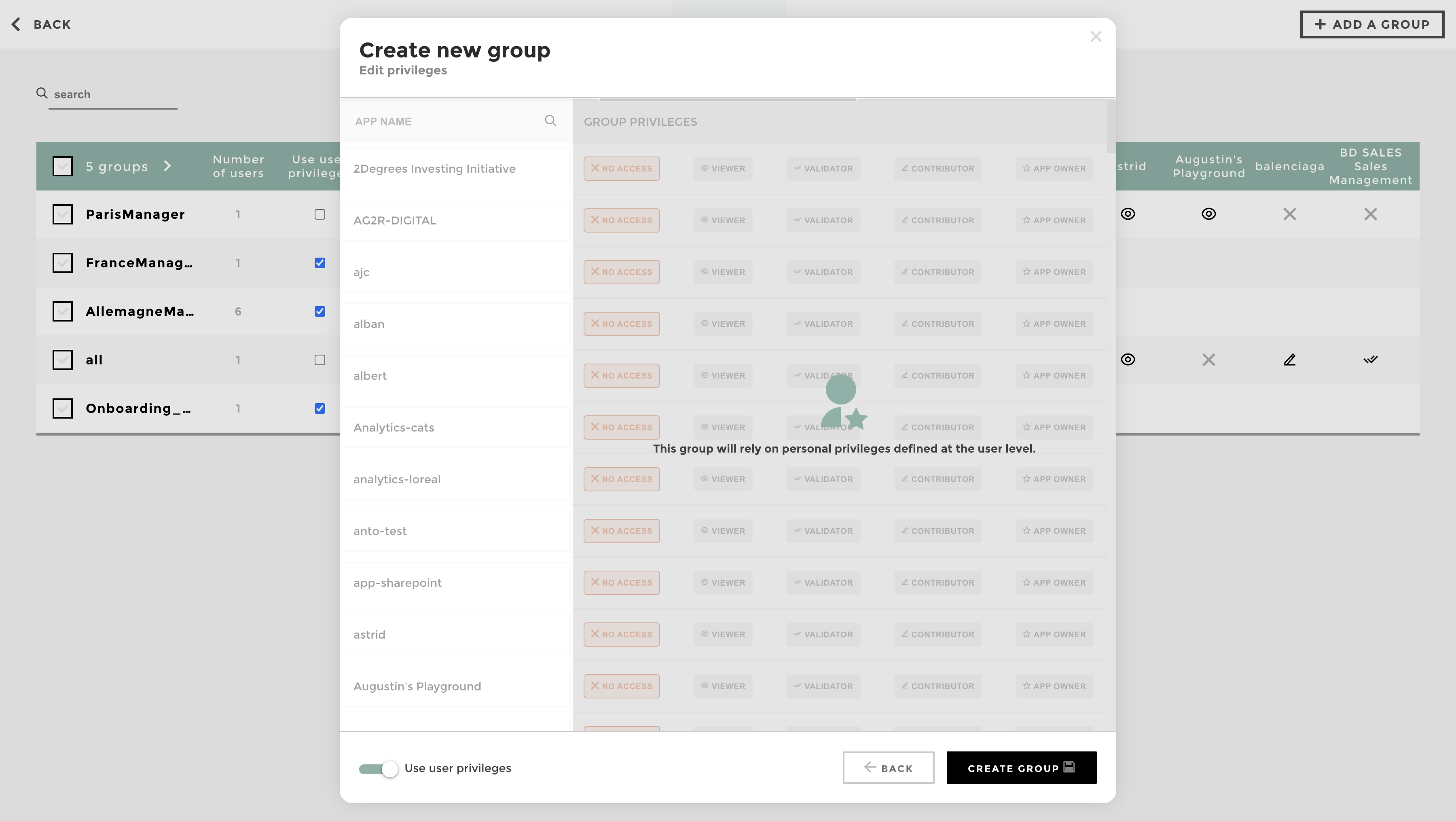
You can also choose not to apply privileges at the group level. Users will keep the app access defined individually (if they don't belong to a group with privileges). Just turn on the option at the bottom left.
{% endhint %}
**Notification settings**
If you choose to use privileges at the group level, you can choose how to notify users of their access 💌.
#### Edit groups
Once your group is created, you can update it directly from the menu.\
From the menu, you can change, on-the-fly, the group app access and notify users belonging to the group. You can also choose to remove privileges at the group level :
* Users that had individual privileges before joining the group will be switched back to their individual access
* Users that never had individual access will have no access by default, and you will need to update their access in the user menu
**Edit one group**
Selecting a group from the menu enables the editing toolbar.\
You can use this toolbar to:
* Add/remove users to/from your group
* Notify users of their access
* Delete the selected group
**Edit multiple groups**
Selecting multiple groups from the menu enables the editing toolbar.\
You can use this toolbar to:
* Add/remove/change privileges of users in the selected groups
* Notify users of their access
* Delete the selected groups
### Permissions
📖 **Learn more** about permissions with [this documentation](/administration/managing-users/setting-up-permissions-and-visibilities.md) !
---
# Agent Instructions
This documentation is published with GitBook. GitBook is the documentation platform designed so that both humans and AI agents can read, navigate, and reason over technical content effectively. Learn more at gitbook.com.
## Querying This Documentation
If you need additional information that is not directly available in this page, you can query the documentation by asking a question.
Perform an HTTP GET request on the following URL with the `ask` and `goal` query parameters:
```
GET https://docs-v3.toucantoco.com/administration/managing-users/managing-user-groups.md?ask=&goal=
```
`ask` is the immediate question: it should be specific, self-contained, and written in natural language.
`goal` is what the user is ultimately trying to achieve, the reason they need the answer. Sharing it helps GitBook give you a better, more relevant answer. A goal is most helpful when it describes the outcome the user wants rather than restating the question. For example, with `ask=how do I create an API token`, a goal like `automate deployments from our CI pipeline` lets GitBook tailor the answer to that use case.
The response will contain a direct answer to the question and relevant excerpts and sources from the documentation.
Use this mechanism when the answer is not explicitly present in the current page, you need clarification or additional context, or you want to retrieve related documentation sections.