> For the complete documentation index, see [llms.txt](https://docs-v3.toucantoco.com/llms.txt). Markdown versions of documentation pages are available by appending `.md` to page URLs; this page is available as [Markdown](https://docs-v3.toucantoco.com/visualizations-and-layouts/apps/stories/kpis.md).

# KPIs

## Overview

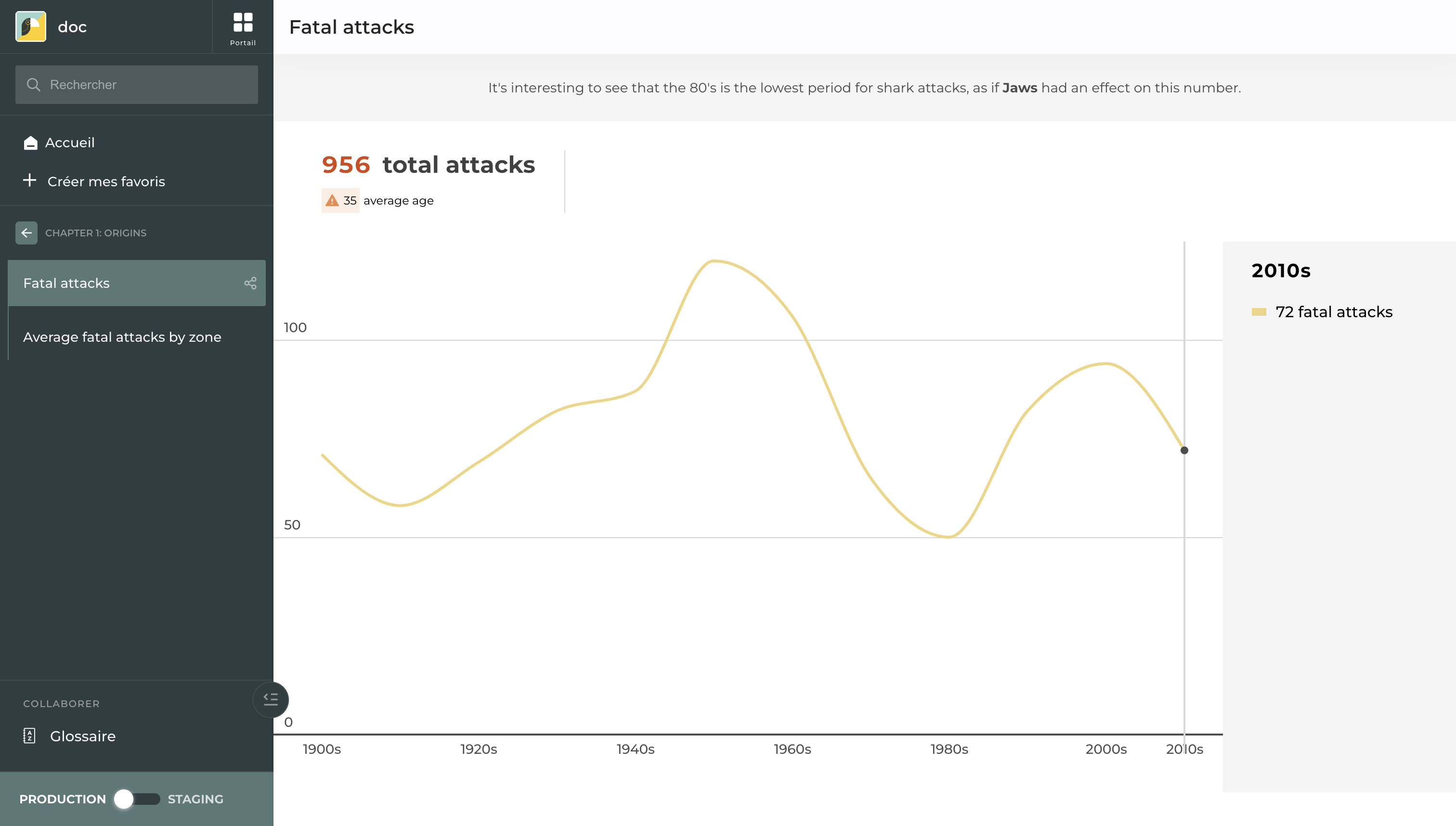
**KPIs add an aggregated metric to a chart** to provide a high-level view metric, a baseline, or any other extra information. It can be a numerical value or some text.

<figure><img src="/files/3MTaaI94fx7c33plw7bo" alt="A story including a KPI"><figcaption><p>A story including a KPI</p></figcaption></figure>

{% hint style="info" %}
💡 **Pro Tips**

* KPIs can also be linked to filters
* KPIs can be used with a [Crossfilter](/visualizations-and-layouts/apps/stories/crossfilter.md) from the parent chart if they use the same dataset
* You can drag & drop KPI to change the display order
  {% endhint %}

{% hint style="warning" %}
**You can add up to 3 HKPIs in one story.** Consider using a dedicated visualization such as a scorecard to show more KPIs.
{% endhint %}

## Configuration

<table><thead><tr><th width="144.33333333333331">Section</th><th width="246">Option</th><th>Configuration tutorial</th></tr></thead><tbody><tr><td></td><td>Dataset (mandatory)</td><td>Select the dataset used by the KPI</td></tr><tr><td></td><td>Value (mandatory)</td><td>Choose the column name containing the value to display</td></tr><tr><td></td><td>Text (optional)</td><td>Add a text to contextualize your KPI</td></tr><tr><td>Other options</td><td>Badge</td><td>Tick to be able to add context such as an additional value or an evolution</td></tr><tr><td>Other options</td><td>Badge - Value</td><td>Column name containing the badge value. Define its and linked symbol. Default to up/own arrow.</td></tr><tr><td>Other options</td><td>Badge - Text</td><td>Add a text to contextualize your badge</td></tr><tr><td>Other options</td><td>Icons choices</td><td>Pick an icon to highlight the related sentiment. Important: configure a sentiment before choosing an icon (<a data-mention href="/pages/1QBP9twbwzWqH3za2W2Q">/pages/1QBP9twbwzWqH3za2W2Q</a>)</td></tr><tr><td>Other options</td><td>Reverse display order</td><td>Toggle to display first the <code>text</code> and then the <code>value</code></td></tr></tbody></table>

{% hint style="info" %}
You can add units, precision, and sentiments. To know more about this watch here:[Add units, precisions and sentiments](/visualizations-and-layouts/creating-visualizations/advanced-chart-configuration/add-units-precisions-and-sentiments.md)
{% endhint %}


---

# Agent Instructions
This documentation is published with GitBook. GitBook is the documentation platform designed so that both humans and AI agents can read, navigate, and reason over technical content effectively. Learn more at gitbook.com.

## Querying This Documentation
If you need additional information that is not directly available in this page, you can query the documentation dynamically by asking a question.

Perform an HTTP GET request on the current page URL with the `ask` query parameter, and the optional `goal` query parameter:

```
GET https://docs-v3.toucantoco.com/visualizations-and-layouts/apps/stories/kpis.md?ask=<question>&goal=<endgoal>
```

`ask` is the immediate question: it should be specific, self-contained, and written in natural language.
`goal` is optional and describes the broader end goal you are ultimately trying to accomplish on behalf of the user. GitBook uses it to tailor the answer towards what is most useful for that goal.

The response will contain a direct answer to the question and relevant excerpts and sources from the documentation.

Use this mechanism when the answer is not explicitly present in the current page, you need clarification or additional context, or you want to retrieve related documentation sections.
