> For the complete documentation index, see [llms.txt](https://docs-v3.toucantoco.com/llms.txt). Markdown versions of documentation pages are available by appending `.md` to page URLs; this page is available as [Markdown](https://docs-v3.toucantoco.com/data-management-in-datahub/datasources-in-toucan/managing-connectors/setting-up-a-connector/online-services-connectors/setting-up-a-hubspot-connector.md).
# Setting up a Hubspot connector
### Configuring a Hubspot connection
{% hint style="info" %}
Warning
This connector is deprecated. It is recommented to use the **HubSpot connector with Private Apps** instead.
{% endhint %}
Create hubspot application
This connector is used to retrieve data from the HubSpot API: [HubSpot API Documentation](https://developers.hubspot.com/docs/api/overview)
The email events part relies for now on Hubspot’s legacy API: [HubSpot legacy API Documentation](https://legacydocs.hubspot.com/docs/overview)
**Create a HubSpot application¶**
First, you need to create a HubSpot application. To do so, you will need a registered [HubSpot developer account](https://developers.hubspot.com/):
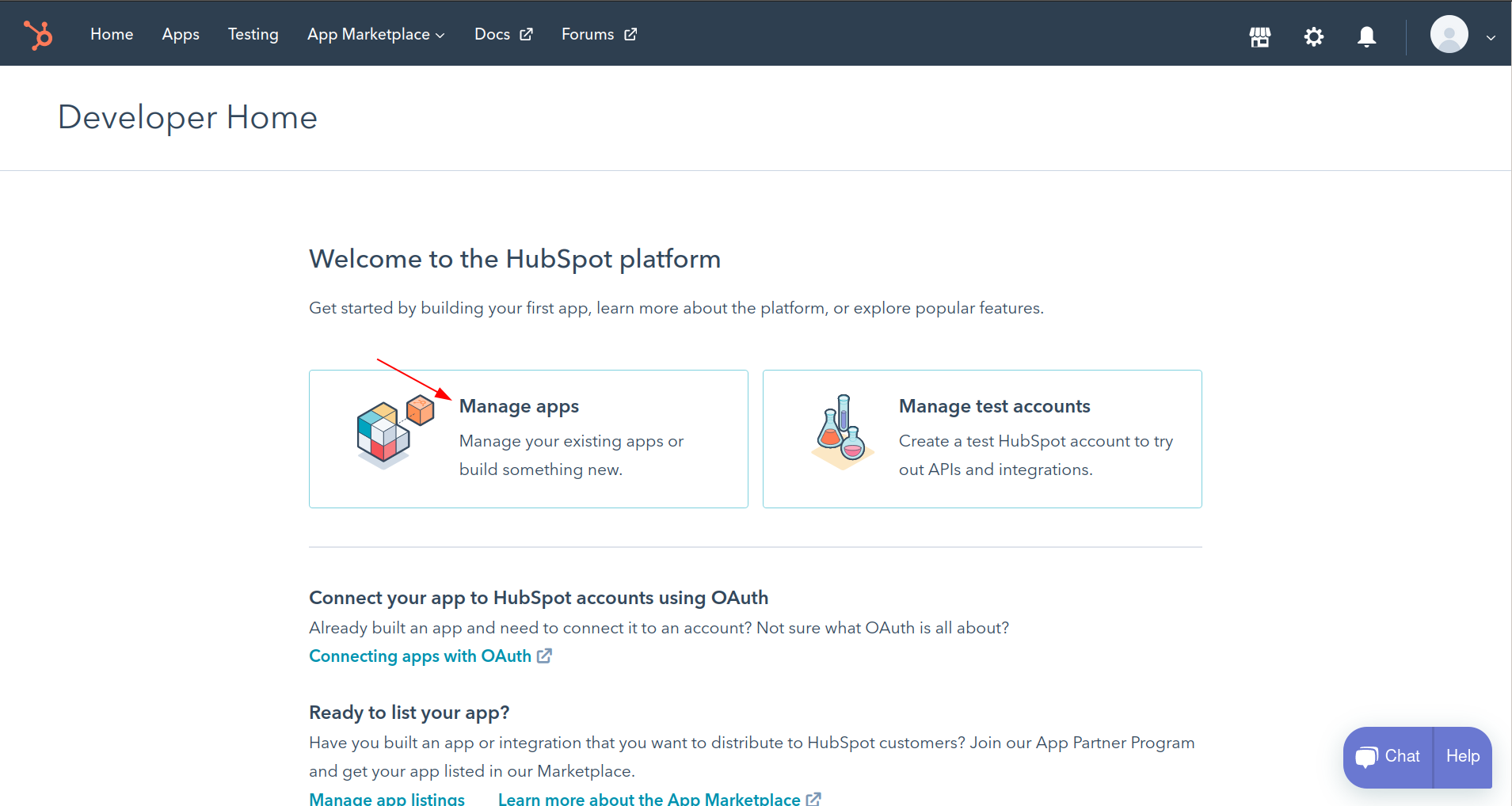
* Head over to `Manage apps`.
Hubpot Manage App Menu
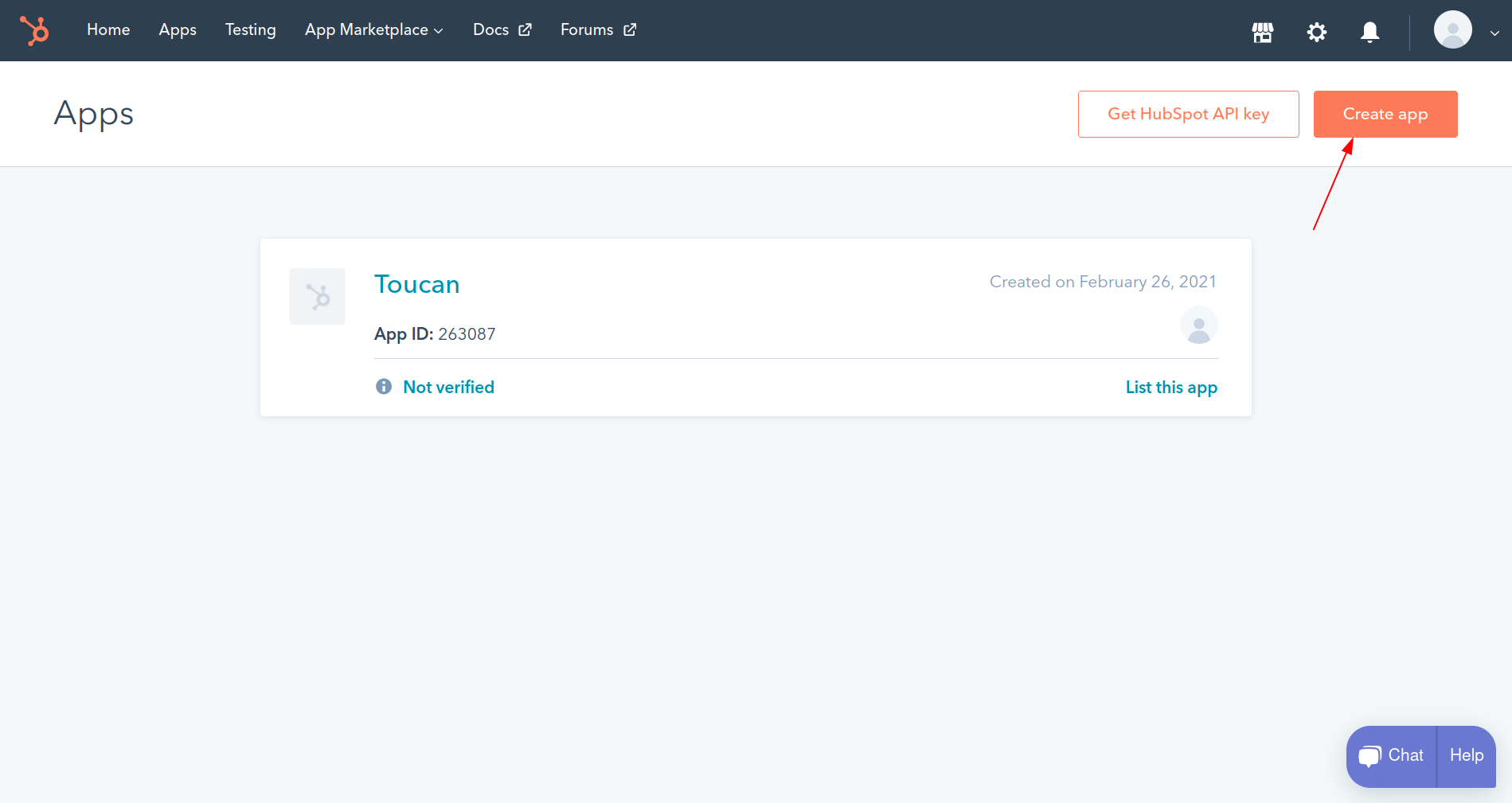
* Click on `Create app`.
HubSpot_create_app
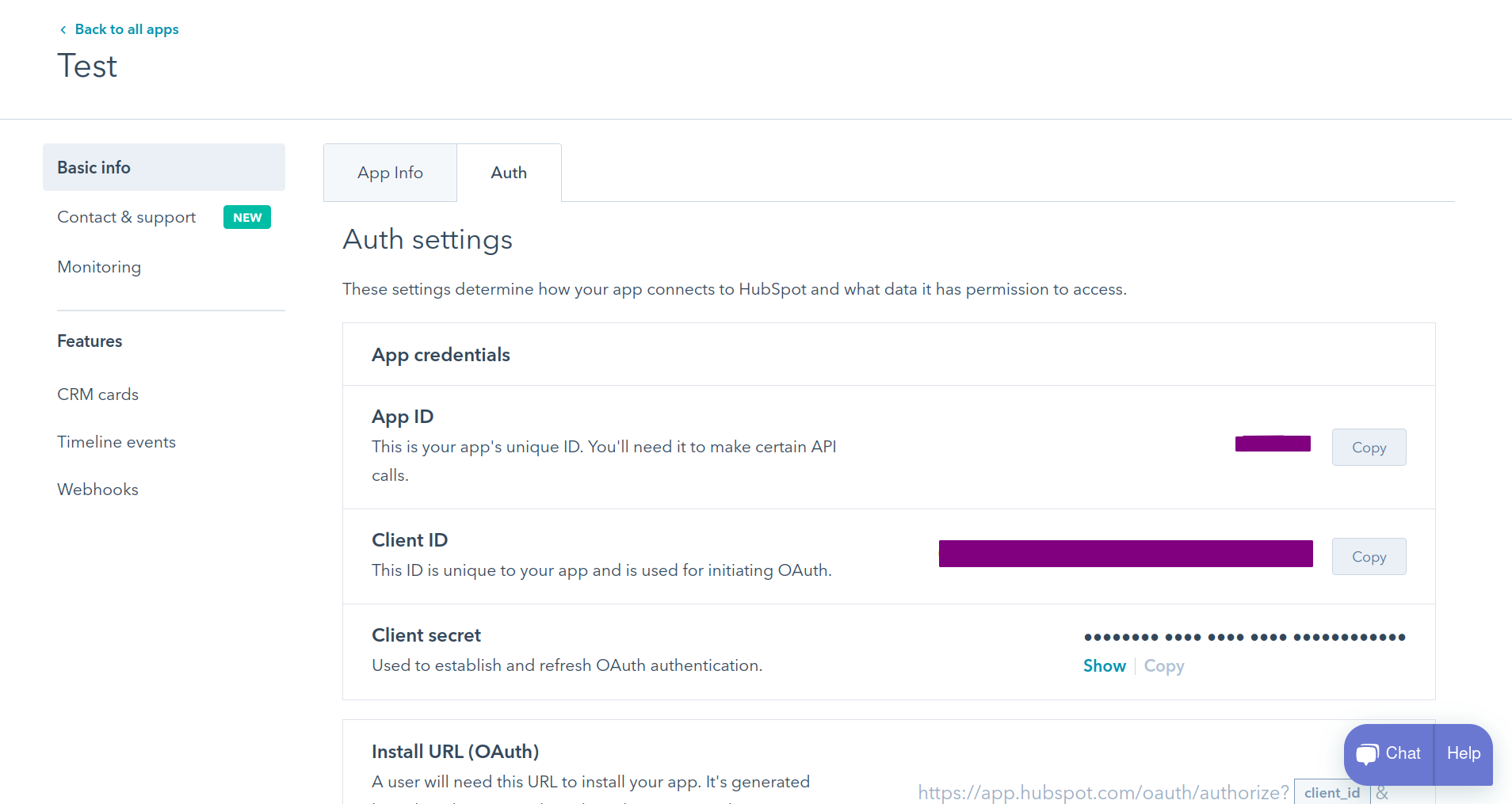
* Once the App Info is filled, click on the `Auth` part, you’ll see the following:
HubSpot_auth_app_layout
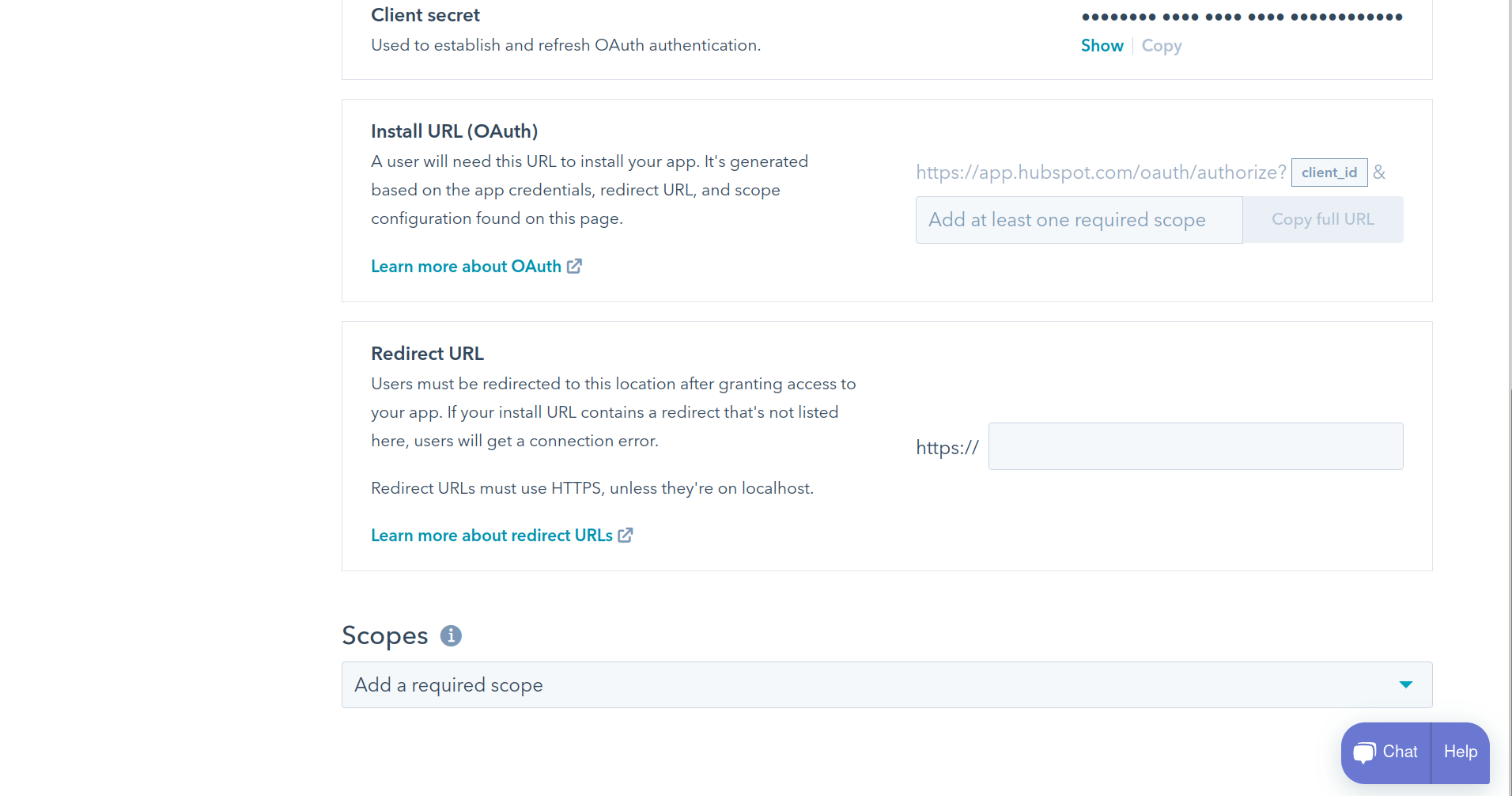
* Scroll down to the “Redirect URL” part and fill up the redirect URI.
* The redirect URI should be like the following pattern:
* `https://api-{your-instance-name}.toucantoco.com/oauth/redirect?type=Hubspot`
HubSpot_app_add_redirect_uri
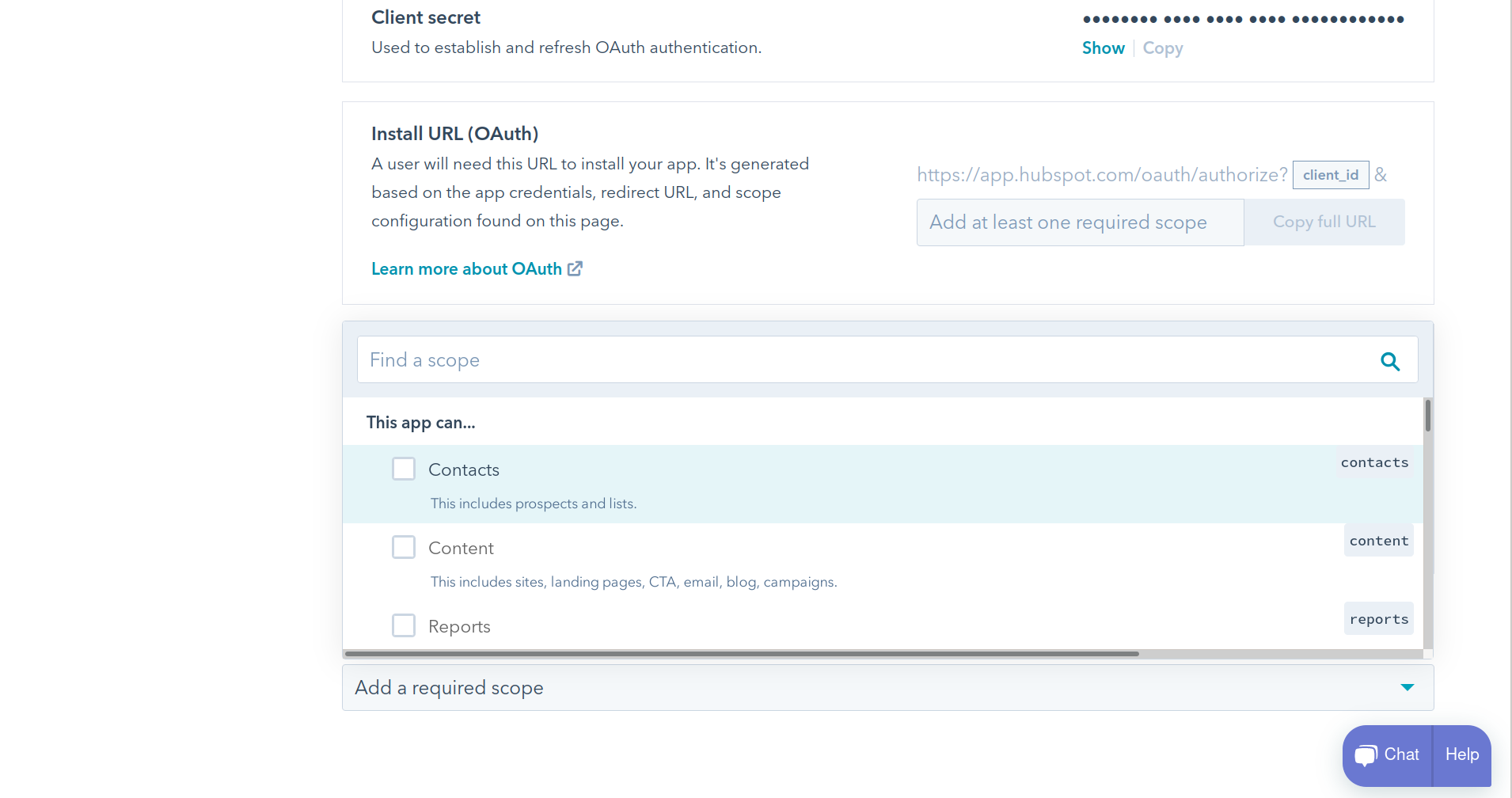
* Scroll down to the `Add a required scope` part:
HubSpot_app_add_scopes
* Then add any combination of the following scopes :
* contacts
* content
* forms
* business-intelligence
* e-commerce
* Note that the connector will not work on certain types of data if a scope listed above is not added to the required scopes of your HubSpot application.
* Do not forget to click on the `Save` button at the bottom of the page when all your modifications are finished.
**How to connect¶**
Once your HubSpot application is created, you will need to set-up the `client_id` and `client_secret` credentials of your previously created application.
Look at [Set up OAuth2 credentials for your platform](https://docs.toucantoco.com/concepteur/power-apps-with-data/02-connectors.html#set-up-oauth2-credentials-for-your-platform) for more information.
{% hint style="info" %}
Once the credentials are set-up, you will need to configure your data provider. All of the pulled data is taken from your HubSpot application, whether it’s about email campaigns, companies, deals, etc.
{% endhint %}
Authentication to Hubspot
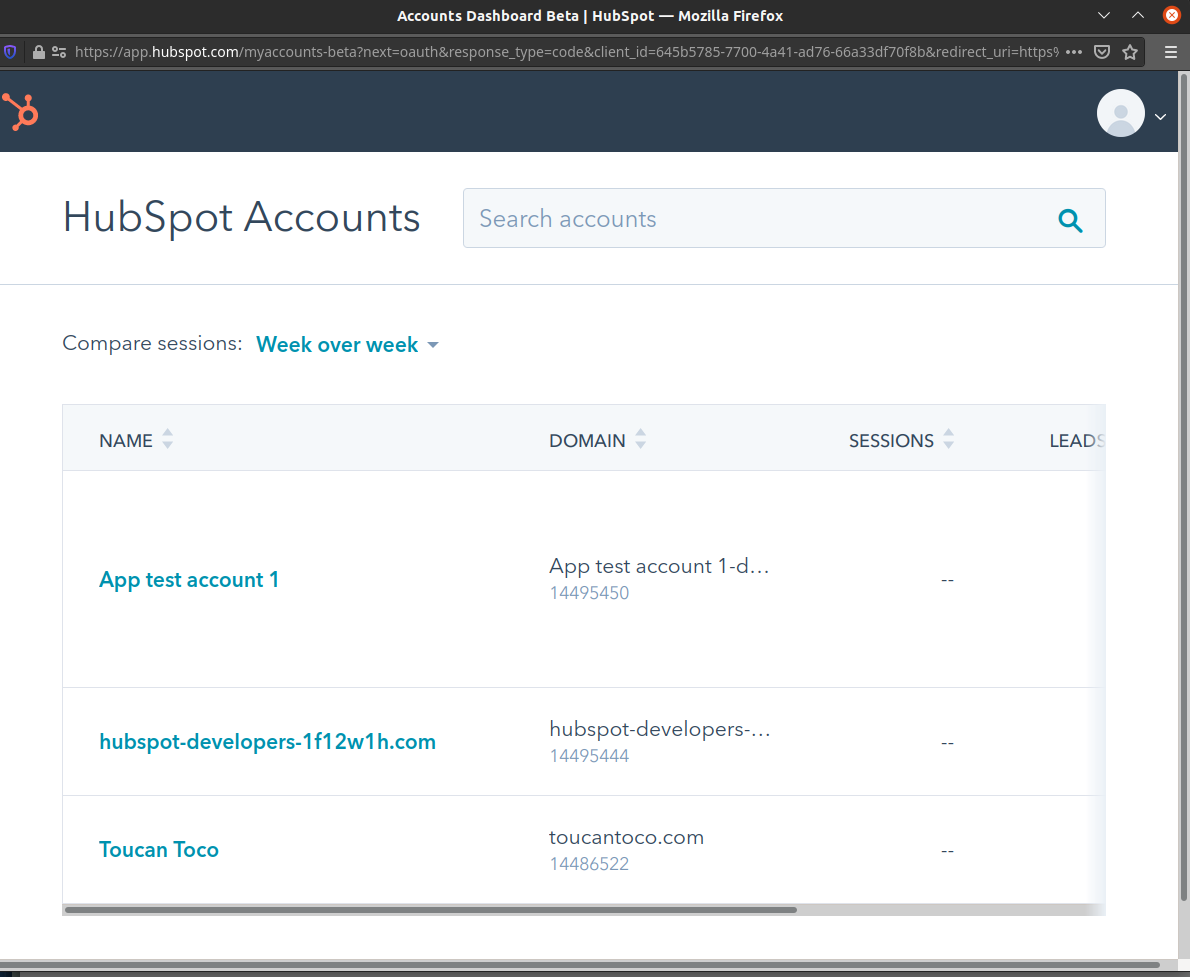
A pop-up window will open and look like this, click on the account that you wish to link to your connector:
HubSpot_create_connector_step_4
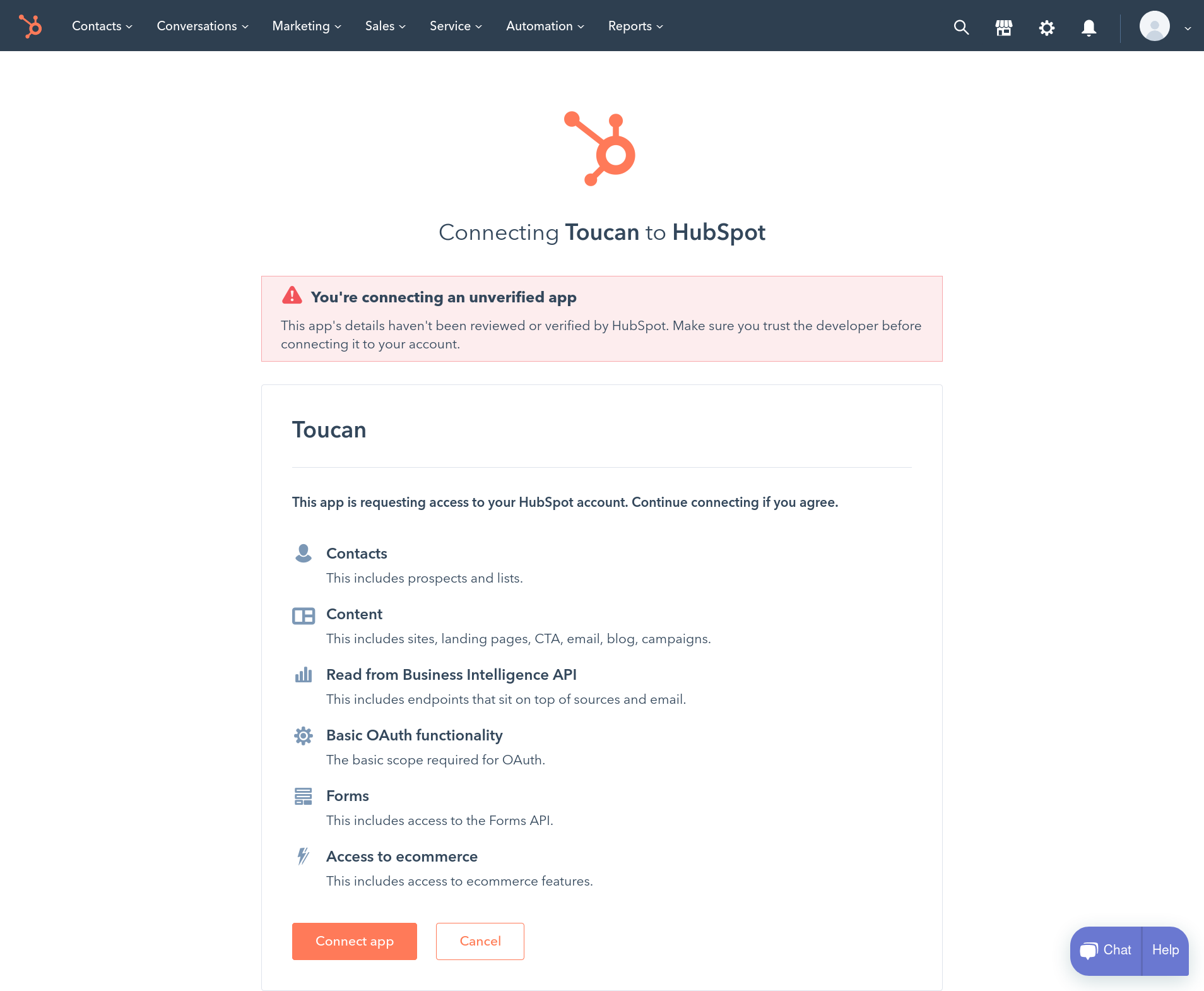
On the next window, all the scopes that are required by the application are displayed; a confirmation is required to link your connector to your hubspot account, just click on `Connect app` to do so:
HubSpot_create_connector_step_5
You will be redirected to your instance with a new popup with two fields: `name` and `Auth Flow ID`. `Auth Flow ID` should be pre-filled and `name` empty.
| Field | Format / Type | Description | Example |
| ---------------------------------------------- | ------------- | --------------------------------------------------------------------------------------------------------------------------------------------------------------------------------------------------------------------------------------------------------------------------------------- | --------------------- |
| Name (mandatory) | String | Use it to identify your connection | *MyHubspotConnection* |
| Auth Flow Id (mandatory) | String | Automatically filled by Hubspot | |
| Retry Policy (optional) | Boolean |
Boolean allows to configure a retry policy if the connection is flaky.
max attempts: maximum number of retries before giving up
max\_delay: in seconds, above the connection is dropped
wait\_time: time in seconds between each retry
| |
| Slow Queries' Cache Expiration Time (optional) | Integer | Slow queries cache expiration time in seconds | |
#### Create a dataset from a Hubspot connection
Once the data provider is configured, it is possible to add one (or more!) data source that will provide data for your apps.
The `HubspotDataset` parameter is needed to define the kind of data you want to query in the following list:
* `contacts` (default value)
* `companies`
* `deals`
* `products`
* `web-analytics`
* `email-events`
The `HubspotObjectType` and `parameters` parameters are needed for the `web-analytics` dataset:
* `parameters` is a `dict`-like object that will contain filters that you want to use to filter the resulting data
* The key must follow this schema: `objectProperty.{property}`, where `property` is a value defined in [HubSpot’s documentation](https://developers.hubspot.com/docs/api/crm/properties)
* The value can be anything
* `HubspotObjectType` has only one value for now (`contact`) but this may evolve in the future
Once you are all set, just hit `SAVE`
### Configuring a HubSpot (with a private application) connection 
This connector is used to retrieve data from the HubSpot API: [HubSpot API Documentation](https://developers.hubspot.com/docs/api/overview)
Create a private application
To create one, follow these steps:
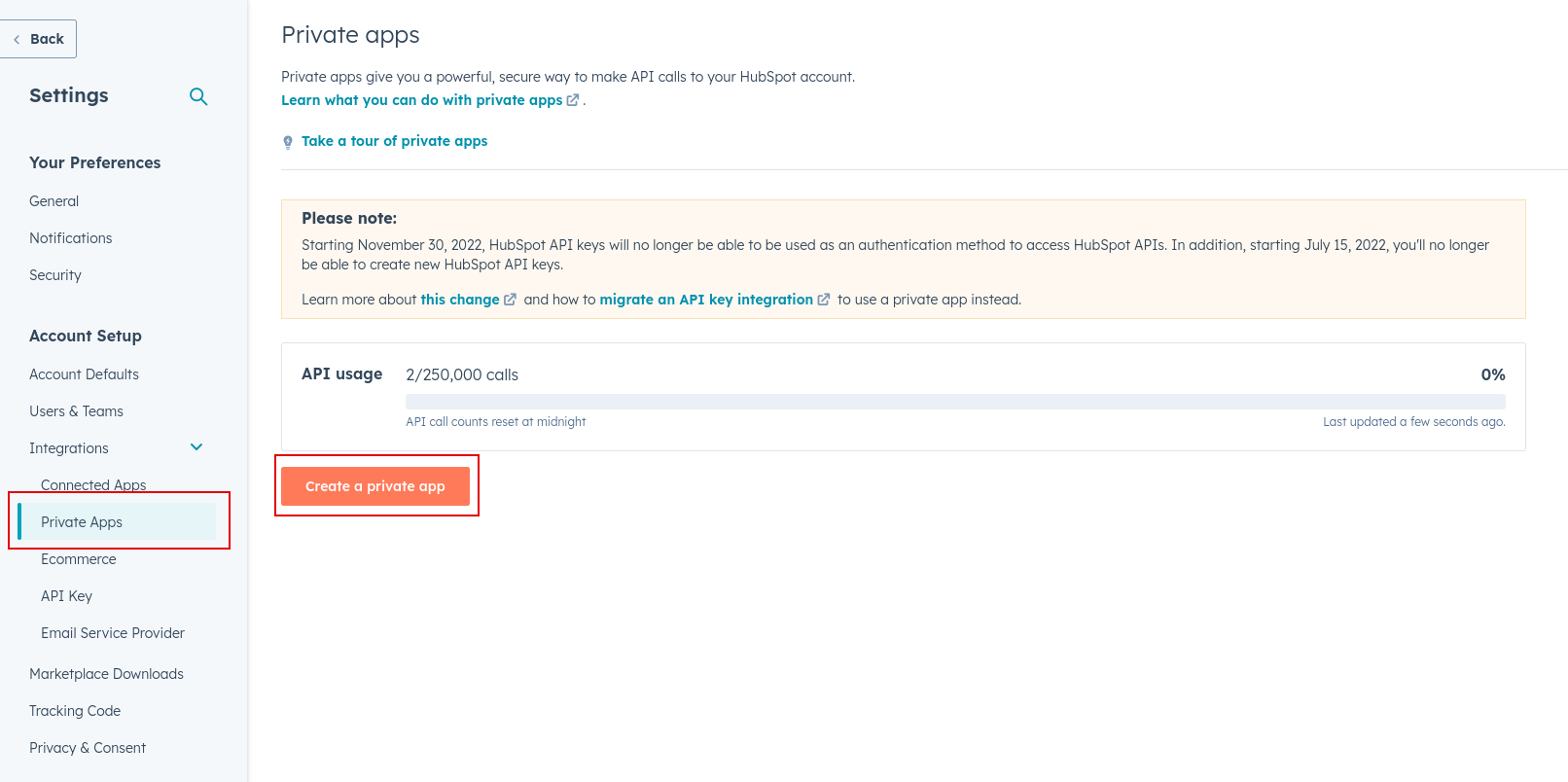
1. Go to the **Settings** page of your HubSpot account (click on the small gear in the top right corner of the page).
2. Head over to the **Account Setup/Private Apps** section.
3. Click on the **Create a private app** button.
HubSpot_private_app_private_apps_menu
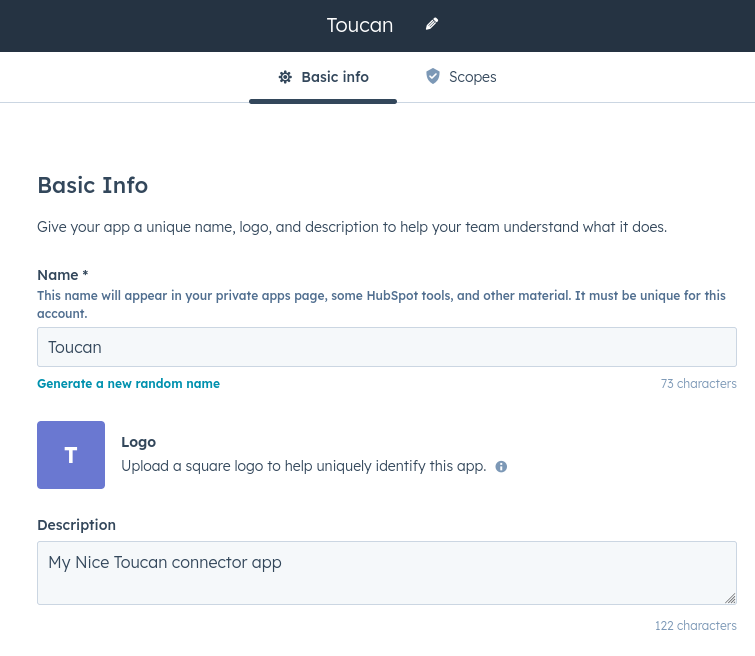
1. Fill out the basic information form.
HubSpot_private_app_basic_info
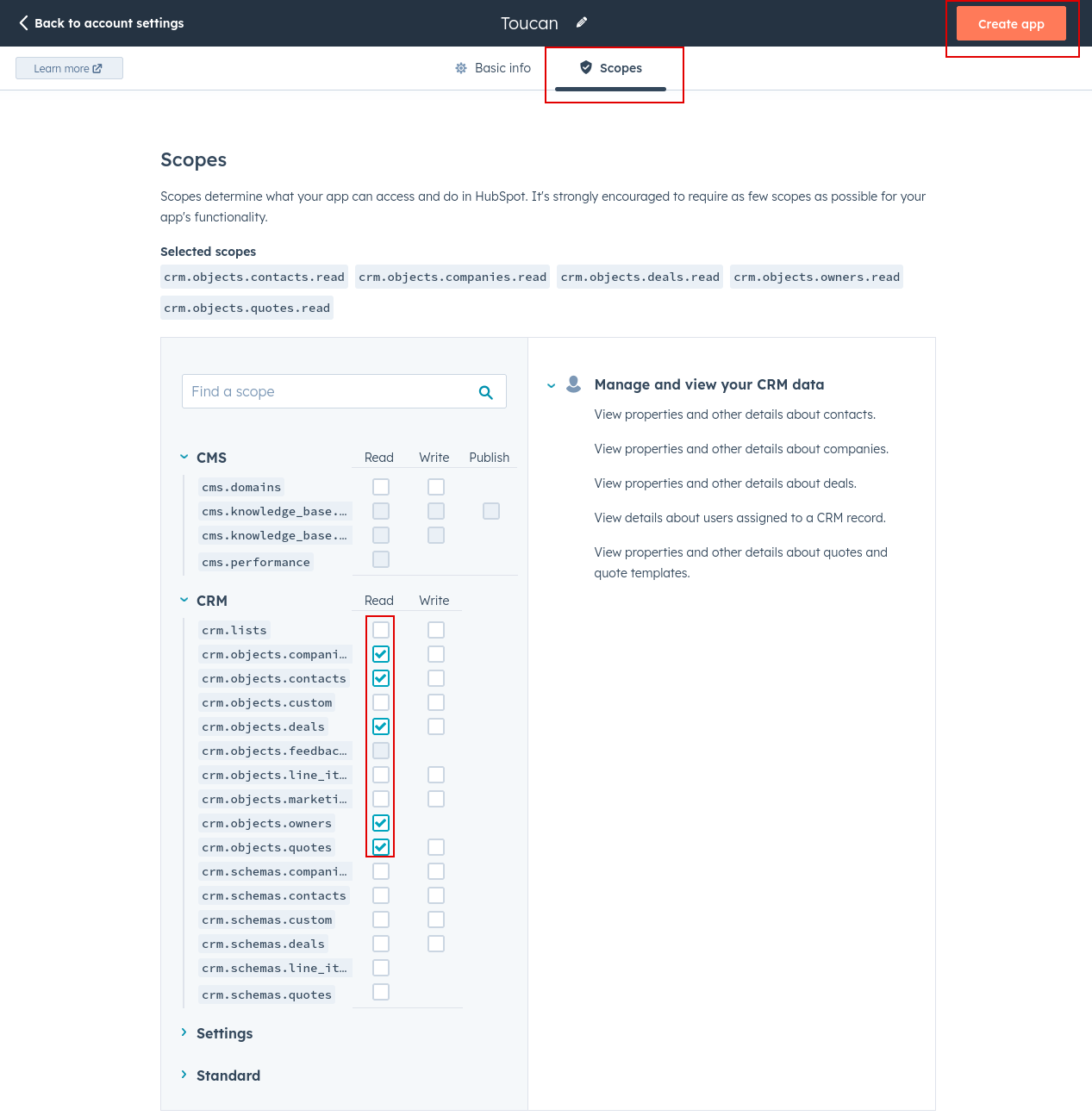
1. Click on the **Scopes** tab. Toucan needs a read access on all CRM objects you want to query. The following objects are supported:
* `companies`
* `contacts`
* `deals`
* `owners`
* `quotes`
2. Once you’ve ticked all the scopes you need, click on the “Create app” button.
HubSpot_private_app_scopes
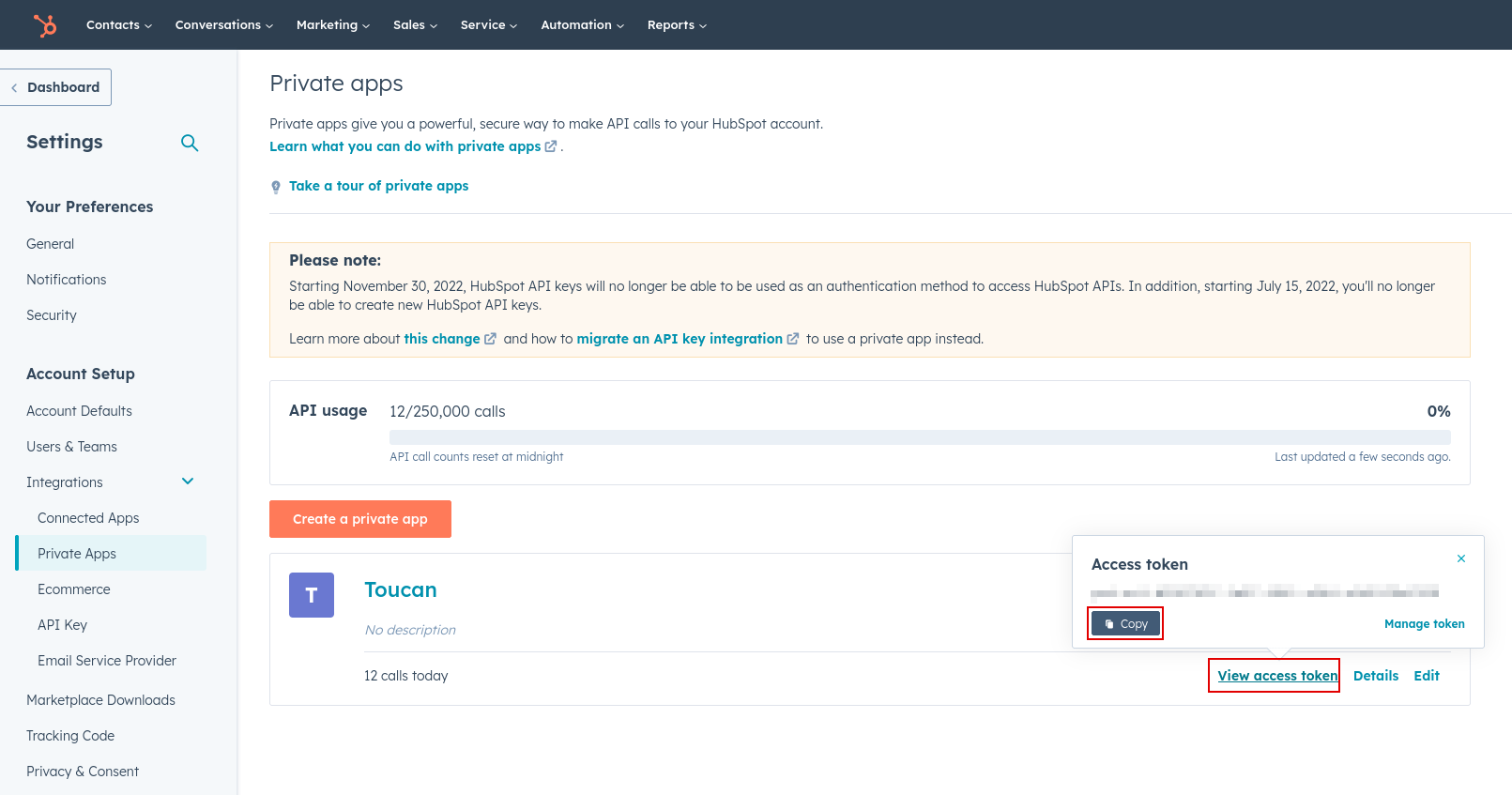
1. You will now need to copy your app’s access token: Click on the **View access token** button, and then on **Copy** in the pop-up.
HubSpot_private_app_view_access_token
Now that your HubSpot private application is created, you can create a connection
| Field | Format / Type | Description | Example |
| ------------ | ------------- | ------------------------------------------------------------------------------------ | ---------------------------- |
| Name | String | Use it to identify your connection | *MyPrivateHubspotConnection* |
| Access token | String | Access token field previously seen in the configuration (will be stored as a secret) | |
## Create a dataset from a Hubspot datasource
The `HubspotDataset` parameter is needed to specify the kind of data you want to query. Pick the desired dataset (note that your private app needs to have the right scopes for that), and click on **Validate** (or **Run preview** if you want a preview of your data first).
---
# Agent Instructions
This documentation is published with GitBook. GitBook is the documentation platform designed so that both humans and AI agents can read, navigate, and reason over technical content effectively. Learn more at gitbook.com.
## Querying This Documentation
If you need additional information that is not directly available in this page, you can query the documentation by asking a question.
Perform an HTTP GET request on the following URL with the `ask` and `goal` query parameters:
```
GET https://docs-v3.toucantoco.com/data-management-in-datahub/datasources-in-toucan/managing-connectors/setting-up-a-connector/online-services-connectors/setting-up-a-hubspot-connector.md?ask=&goal=
```
`ask` is the immediate question: it should be specific, self-contained, and written in natural language.
`goal` is what the user is ultimately trying to achieve, the reason they need the answer. Sharing it helps GitBook give you a better, more relevant answer. A goal is most helpful when it describes the outcome the user wants rather than restating the question. For example, with `ask=how do I create an API token`, a goal like `automate deployments from our CI pipeline` lets GitBook tailor the answer to that use case.
The response will contain a direct answer to the question and relevant excerpts and sources from the documentation.
Use this mechanism when the answer is not explicitly present in the current page, you need clarification or additional context, or you want to retrieve related documentation sections.